Showing posts with label The Great Ones. Show all posts

Monday, September 22, 2008

The Great Movies, vol. 3: Boogie Nights


Director Paul Thomas Anderson hit pay dirt last year with his critically lauded epic, There Will Be Blood. It featured a towering performance by Daniel Day Lewis (for which he won a richly deserved Academy Award) and some truly wonderful visuals. In short, it deserved it's acclaim. But it's another of Anderson's films that I always include of my list of top ten favorites. That film, epic in it's own way, is Boogie Nights.

For the uninitiated, Boogie Nights tells the story of a a group of porno film makers in the late 70's and early 80's. It's content is startling, to say the least, because of it's subject. But the affection that Anderson shows for this group of "losers" let's us see them in sort of a neutral way, making us more witnesses than judges. This serves the characters well, as most of them are truly memorable despite what they do for a living, not because of it.

Mark Wahlberg portrays Eddie Adams, a simple teenager from a dysfunctional family. When he (and his "special talent" - think bulging trousers) are spotted by porno film maker Jack Horner (Burt Reynolds), his life is instantly transformed into something most teenage boys surely dream of: becoming the top dog of the porno acting world. Horner has an already-established stable of actors as his surrogate family. These include Amber Waves (Julianne Moore), Buck Swope (the ever-wonderful Don Cheadle), Rollergirl (Heather Graham, always on roller skates) and Reed Rothchild (the hilarious John C. Reilly). Soon Eddie has given himself an appropriate porno moniker, Dirk Diggler, and he and the "family" are making very successful porn movies. He and Reed Rothchild hit it off immediately and become best pals with a friendship based on bragging and bullshit. Amber Waves is immediately attracted to Eddie/Dirk, but also feels the need to be a mother figure to him. There is a reason for this: she and her ex-husband are in the midst of a custody battle and he is using her profession as a reason to have her declared an unfit mother. She has already become a mother figure to Rollergirl, who has her own issues regarding her chosen career path.

In fact, all of the characters are dealing with revelatory, life-changing moments. Jack Horner is fighting off the advances of the video age. He insists on making real "movies" using film. His money man, "Colonel" James, backs him up, but he has his own demons which will eventually consume and destroy him. Meanwhile, Buck Swope wants to go legitimate and open his own stereo store, but it's hard to secure a bank loan when your application asks for your source of employment and you have to list the porno industry. Buck is looking for a break. When he finally gets it, it is one of the most chilling/crazy/funny moments in recent memory.

Eddie/Dirk rapidly ascends up the porno acting ladder, becoming an award-winning, top-grossing star. We see his rise as a wide-eyed boy and witness the crash as he descends into a hellish, cocaine-fueled nightmare. Eddie's drug habits have a direct effect on his film/sex performances and he spins into a paranoid abyss. When Reed's friend Todd (a virtually unrecognizable Thomas Jane in a stellar performance) enters the picture, things go from bad to dangerous.

Throughout all of this, Anderson wonderfully captures the essence of the era through music, dialogue and visual touches. The soundtrack is wondrous, a virtual audio tour through the 70's/80's Being from that time frame myself, it really touches a chord and sends me back in time each and every time I watch the movie.

The treasures of this film are many. There are scenes so funny your sides will split (particularly Eddie and Reed's foray into the music business), while others are so intense (think Alfred Molina, firecrackers and "Jessie's Girl") that you will be beside yourself with angst as the film plays out. There are a ton of great performances here, from the aforementioned to Julianne Moore, Burt Reynolds, William H. Macy as a director with a nagging problem and Philip Seymour Hoffman as the lovelorn sound man. It all adds up to a rich tapestry that I think is every bit the equal of Tarantino's classic Pulp Fiction. Watching these flawed, real characters try to make something of themselves in an unseemly world is in turns chilling, funny and horrifying. This film is not to be missed.

Monday, August 11, 2008

The Great Albums, vol. 3: The Beatles - Rubber Soul


Folks, it just doesn’t get any better than The Beatles. They are widely acknowledged to have been not only the most popular band of the modern rock era, but also the best. Their music has proved to be timeless; nearly 40 years after their break-up, they are still essential listening and their influence can still be heard in modern music.

But picking a favorite Beatles’ album is a dicey proposition. Their albums were almost all universally strong, filled with classic songs and performances that delight people to this day. I am of the opinion that you can make a strong argument for no less than 5 albums in looking for the best one. (Note: I am referring to the original UK releases, not the American versions which often contained different tracks and track orders.) These top 5 are A Hard Day’s Night, Rubber Soul, Revolver, The Beatles (The White Album) and Abbey Road. Sgt. Pepper’s Lonely Heart’s Club Band, probably their watershed album, falls just short for me, as do the excellent Beatles For Sale and Help! In fact, in their entire catalogue, only Yellow Submarine is not a complete success, as it is filled with a lot of instrumental music from the film.

Despite the difficulty in claiming any one Beatles album is better than the rest, it has always been my opinion (and it remains so today, if a bit more tenuously than in the past) that Rubber Soul is the best. It marked a real departure for The Beatles as their songs became more introspective and mature. Heavily influenced by The Byrds and Bob Dylan at the time, Rubber Soul has more of a folk/rock feel to it than the earlier Beatles’ albums. It definitely finds the Beatles in a more experimental mode, especially with George Harrison showing his Eastern music influence by introducing the sitar in “Norwegian Wood (This Bird Has Flown).”

For Rubber Soul, The Beatles were in the midst of their “middle period” where they really honed their songwriting skills and moved beyond the more immature (but still brilliant and ground-breaking) rock and roll of their early days. The Beatles released 3 albums in this so-called middle period: Help!, Rubber Soul and Revolver. Each is a classic in its own right and many people to this day consider Revolver to be The Beatles’ peak. I happen to disagree, even if not by much.

In the early days of the Beatles, John Lennon was unquestionably the leader. By the middle period, however, it was clear that Paul McCartney had become his equal as a songwriter, and George Harrison was rapidly developing his songwriting skills as well. Each has glorious moments on Rubber Soul. The album kicks off with “Drive My Car,” a song jointly composed by Lennon and McCartney. The jaunty, humorous bent to the song signals the Rubber Soul will be different from past Beatles’ albums. That is immediately confirmed by the next song, Lennon’s “Norwegian Wood.” Written about a tryst with a groupie, the song is considered a confessional to the then-married Lennon’s wife, Cynthia. It is also well known for the aforementioned sitar as well as it’s own humorous conclusion.

McCartney is up next with his wonderful “You Won’t See Me,” full of beautiful harmonies and a compelling lead vocal. Lennon’s “Nowhere Man” follows and it is a stunner. Picking up where “I’m A Loser” (from Beatles For Sale) left off, the song tells the story of a lost man who doesn’t realize the world is passing him by. This song is often considered to be another confession by Lennon, confronting himself on what he felt was an empty life. Harrison’s first song on the album is the fine “Think For Yourself,” which benefits greatly from McCartney’s fuzz bass guitar. Another joint Lennon/McCartney composition, “The Word,” follows. Side 1 of Rubber Soul closes with a true classic, McCartney’s beautiful, Grammy-winning “Michelle.”

Side 2 kicks off with Ringo singing lead vocals on “What Goes On” which he co-wrote with both Lennon and McCartney. If there is a weak track on the album this is it, but it does show off some fine guitar work by Harrison and as always, the harmonizing is first-rate. A minor Lennon classic, “Girl” is memorable for Lennon’s lead vocal and playfully biting lyrics. McCartney pulls no such punches with the next song, “I’m Looking Through You.” Chastising a “changed” lover, lines such as “Love has a nasty habit of disappearing overnight” pretty much sum up the feelings of a song that many think McCartney wrote for his then girlfriend, Jane Asher.

Up next is another Lennon/McCartney collaboration and it’s one of the more timeless songs in the entire Beatles’ catalogue. Comprising mainly of Lennon’s lyrics set to McCartney’s music, “In My Life” is an absolutely lovely, introspective look at life, relationships and love and it’s message is just as powerful and meaningful today as it was back in 1965. McCartney and Lennon team up again on “Wait” and then Harrison makes a strong impression with “If I Needed Someone.” With it’s jangly guitars and brilliant harmonies, it’s the most obvious shout-out to The Byrds and their influence on the Beatles at that time. The album closes with one of Lennon’s patented jealous-guy songs, “Run For Your Life.” With it’s protagonist proclaiming, “I’d rather see you dead little girl than to be with another man,” The Beatles are a long way from “I Want To Hold Your Hand” territory indeed.

Rubber Soul was recorded in just 4 weeks and rushed out in time for release for Christmas of 1965. Critics immediately hailed it as a masterwork and it shot to the top of the charts in Britain, where it stayed for 8 weeks. In 2003, the album was ranked #5 on Rolling Stone’s 500 Greatest Albums Of All Time list. In 2006, Time Magazine named it one of the 100 best albums of all time. Like nearly all of the Beatles’ music, Rubber Soul remains timeless and a testament to the incredible talent of The Beatles.

Tuesday, July 1, 2008

The Great Novels, vol. 2: The Alienist


The year is 1896. The City is New York.
The hunt is on for a baffling new kind of criminal...

A serial killer.

This is the reading experience of a lifetime.

So read the cover of the paperback edition of Caleb Carr's tremendous suspense novel, The Alienist. I was hooked immediately and bought it on sight. I had read an enthusiastic review of the novel when it was first published in hardcover, so I kind of realized what I was getting into. But I had no idea that it would wind up being one of my favorite works of fiction. I started reading the book on a flight down to Florida, where I was heading for a week of vacation. I ended up finishing the book just a couple of days later; it was too hard not to go back to it, even while staying at a beach side resort.

I have recommended this book to lots of people and the most frequent response has been, "I'm not really into science fiction." Well, neither am I. And despite the strange title, The Alienist has nothing to do with sci-fi. You see, back before the turn of the century (the late 1800's; I keep forgetting about the recent turn of the century), people who were mentally ill were thought to be "alienated" from society. The experts that studied such people were therefore called alienists. They were the forerunners of psychology.

As noted earlier, the novel takes place in 1896. It is a time when future president Teddy Roosevelt is the New York City Police Commissioner. A series of ghastly murders begins; young boys who are paid to dress up as girls to prostitute themselves are being found not just murdered, but strangely mutilated as well. Roosevelt, who is new on the job as commissioner and clashes with the old-school police and high society (due to his effort to fight corruption) stakes his reputation on an unusual team he gathers to solve the crimes. He turns to well-known alienist Dr. Laszlo Kreizler to figure out not only who is committing these heinous crimes, but why they are compelled to do so. Kreizler is a compelling character, supremely intelligent and far ahead of his time but also widely distrusted by virtually everyone, as the study of the human mind was in it's infancy and often seen as crackpot science. Roosevelt has known Kreizler for a long time, however, and trusts his theories. Mutual friend John Moore, a crime writer for the New York Times is brought along by Kriezler, and it is through his eyes the story unfolds. Moore narrates the book and gives a spellbinding account of not only the crimes, but also turn of the century New York. The novel does a terrific job of actually transporting the reader back in time, to a place where carriage rides through dusky street lamp lit roads was the norm.

Kreizler and Moore also recruit Sarah Howard, a strong, fiery woman who yearns to be the first female police officer in the city. Steve Taggert and Cyrus Montrose, two former patients of Kreizler now in his charge, join up and serve various purposes. Roosevelt also wants an official police presence on the team and adds the brothers Isaacson, Marcus and Lucious, who are detective sergeants with a keen interest in criminal science. Through these brothers, we are introduced to radical new procedures such as fingerprinting and other, less successful methods of evidence gathering. And although Roosevelt doesn't interfere, he casts a large shadow over the whole investigation.

As more bodies turn up, it becomes obvious that the immense social divide between rich and poor will only make things more difficult for our investigators. The lowlifes and gangsters don't want their profitable businesses (including prostitution) to become the focus of a police investigation. The rich, meanwhile, don't even want to hear of such sordid crimes and don't care one whit about the victims, as they are "undesirables" to begin with. Narrator Moore shows us both sides of the city and the culture war boiling below the surface.

The investigation takes many twists and turns, dead ends are numerous and promising leads vanish into thin air. All the while, Kreizler keeps us well informed about then-modern psychiatric theories and why he agrees (or disagrees) with them. These ruminations are fascinating and give discreet clues at to what is going on. As the teams gets closer to the answers, they also come closer to alienating everyone in the city: the rich, the poor, the gangsters and of course, the actual killer. And no one around them can be trusted.

Finding the killer is no easy task as they are basically looking for a needle in a haystack. With such seedy characters all around them, there is no shortage of suspects and no shortage of danger either. The pressure on them is enormous as the gangsters push back, the rich try to make it all go away, and the police board and society puts Roosevelt under terrific strain. It bears noting that the Roosevelt character is terrific, full of gumption and vigor, and he becomes flesh and blood before your eyes. Carr does a tremendous job of drawing him out fully and the novel is all the stronger for it.

The Alienist is many things: a page turner, a suspense thriller, an historical work of fiction and a treatise on the early days of psychology. It does all of these things remarkably well and the sum winds up being even greater than the parts. One of the original reviews stated that it was a cross between The Silence Of The Lambs and Ragtime. That's a great line, but mostly because it is completely accurate. You'll be enthralled by the crimes and investigation as well as 1890's New York come to life. Come for the suspense and stay for the atmosphere. The Alienist has it all in spades.

Sunday, June 1, 2008

The Great Movies, vol. 2: Jaws


As a 9 year old boy during the summer of 1975, I witnessed the single greatest entertainment experience of my life: my father took me to see Steven Spielberg's Jaws. Now this was in September of 1975 and the movie had opened earlier in June and was already a phenomenon the world over, so I was a little late to the party. But by then I had pumped so much information out of my friends who had already seen the movie that I knew the entire story inside and out. I mean, I knew it all: I knew about each victim of the shark, I knew about the tiger shark that was caught and erroneously thought to be the killer, I knew how it ended, ...everything. I remember my teenage neighbor saw the movie and when he came by to tell us about it, I was finishing his sentences, knowing everything he was saying about the movie. And I distinctly remember him saying, "I don't know why to still want to see it, you know it all already."

Ah, but that was just it; I hadn't seen it yet, experienced it with my own eyes. I already knew it was the greatest adventure story I had ever heard. But to actually see the events unfolding on screen...well, that was something I had to behold for myself. And so that September, I finally talked my dad into taking my brother and me to see Jaws. My uncle Jim came along with us. And when the lights went down and that awesome John Williams music started, I was already a goner. What made Jaws so special for me was that beyond all possible hope, it lived up to my expectations. I had never before so eagerly anticipated something and all experience since then has taught me that nothing can ever live up to the hype. Well, Jaws did. And it still does for me today.

Based on Peter Benchley's best-selling novel of the same name, Jaws tells the simple story of the town of Amity, a tidy Long Island beach side community that relies on the summer tourist trade to keep it going through the long, cold winters. When the body of a swimmer killed during a late night skinny-dip is found on the shore, the coroner tells police chief Martin Brody (Roy Scheider) that the girl was the victim of a shark attack. When Brody responds by ordering the beaches closed, Amity's mayor, worried that such a move will kill the summer tourist business, convinces the coroner to change the official cause of death to a boating accident. Brody does not agree but has no choice but to go along. Days later when a young boy is killed by a shark in front of numerous beach goers (including Brody and his family), Brody is proven correct and a town meeting is called. After Brody announces that the beaches will be closed, the attending citizens panic and the mayor decrees that the beaches will only be closed for 24 hours, much to Brody's chagrin. The meeting is then interrupted by a loud screech as one of the great movie characters of the 70's is introduced; for running his fingernails down a blackboard is the local shark fisherman, known simply as Quint. He informs the town that the shark is a big problem and one that he is not willing to risk his life over for the standing $3000 reward. He will find and kill the shark, he says, for $10,000. The mayor is dubious and vaguely promises to consider the offer.

The character of Quint is played by the late, great Robert Shaw, and he is absolute perfection playing a salty old fisherman who has his own personal demons and reasons for hunting and killing sharks. It is a tour de force performance that remains etched in the memories of many, many film-goers. How we has overlooked for an Academy Award nomination is one of the great mysteries of the 70's, right up there with the leisure suit. Anyway, back to Amity and it's little shark problem.

Except that it's not a little shark problem, it's a BIG shark problem. When local fishermen haul in a large tiger shark, the mayor is convinced the killer has been caught and that the beaches are safe again. Matt Hooper (Richard Dreyfus), a shark expert called in by Brody, examines the remains of the first victim and determines that the tiger shark cannot be the killer. He proves this with a quick late night autopsy on the tiger shark. He and Brody, who by the way is deathly afraid of the water (the fact that he lives on an island is a running joke throughout the movie), head out to see if they can find any sign of the shark at night. Hooper's sonar gear picks up a large object, but it is not the shark; it is the half-sunken boat of victim #3, a local fisherman whose body Hooper discovers in a truly shocking scene. And that's not all Hooper finds. He also finds a tooth embedded in the hull of the boat. It is the tooth of a great white shark and it is huge. Unfortunately, Hooper drops the tooth when he is startled by the appearance of the victim, and neither he nor Brody can convince the mayor to close the beaches again. For tomorrow is the 4th of July, you see, the biggest day of the summer for Amity's tourist season.

Of course when the holiday arrives, Mr. Shark makes an appearance and kills a boater in the estuary, nearly taking Brody's son with him. A highly peeved Brody forces the mayor to hire Quint to kill the shark, for the summer season is over in Amity. No one will be swimming there until the real shark is killed. Brody convinces Quint to take him and Hooper along for the hunt. Right away there is a clash between Quint's old school ways and Hooper's technological approach to finding the shark. Brody, who is scared out of his wits to be on a boat in the first place, is caught in the middle. And here is what separates Jaws from the average thriller: the characters are real. You believe that there is a Quint, and a reason that he behaves the way he does. Same for Hooper, the quirky, educated guy that has a razor sharp wit. And Brody, the everyman, is a flesh-and-blood character as well, a man that you hope and pray somehow survives this saga and returns to his family safe and in one piece. These are not the cardboard cut-out characters you find in modern day thrillers, they are real personalities. And it makes all the difference in the world.

Once aboard Quint's boat, the fabulously rickety "Orca", the chase is on. The Orca is one heck of a set piece, a character in itself where you witness some of the most intense action you can imagine. It becomes a claustrophobic nightmare for Brody, while Quint and Hooper are completely in their element. The level of suspense during the hunt is propelled by Spielberg's impeccable directing and John Williams' soaring musical score, which rightfully won an Oscar.

Quint is able to harpoon the shark and has a floating barrel tethered to the harpoon. The drag from pulling this barrel will tire the shark and keep it from diving. The men decide to stay out at sea overnight in order to keep an eye out for the barrel. Chasing their fear away with a few drinks, they begin comparing scars and telling stories and it is here we learn of Quint's dark past. A sailor during World War II, his ship was sunk by a Japanese submarine and 1,100 men were adrift in the water for days. Sharks quickly arrived and began devouring the sailors in plain sight. Witnessing many friends killed in the most horrible of ways, the young Quint would survive and go on to become a shark fisherman, taking private revenge against the beasts that still haunt his dreams.

The shark interrupts their drinking and before too long, the hunters become the hunted. Quint continues to harpoon the shark, but is awestruck when the shark continues to dive, even with two, then three barrels attached. The great white turns the tables on the men, ramming the Orca repeatedly and springing several leaks in the hull. Quint, finally rattled, heads for shore, the shark chasing them all the way. When Quint stubbornly refuses to slow down, the engine overheats and finally blows and the Orca is left listing dead in the sea, taking on water. Brody, who can't swim, faces the realization that he is likely to either face his biggest fear, drowning, or be eaten by the shark. In a last ditch effort to save their hides, Quint calls upon Hooper's modern equipment to kill the shark.

Lowered into the water in an anti-shark cage, Hooper is immediately set upon by the shark. The cage is no match, and soon the shark's head is inside the cage and the mouth is reaching, straining to get a bite at Hooper. But the shark gets tangled in the cage's tethering lines and Hooper is able to swim to the ocean floor, where he hides among the rocks. Brody and Quint, unable to see what has transpired in the water beneath them, desperately haul up Hooper's cage, only to find it mangled and empty. The shark then surfaces, leaping out of the water and onto the back of the Orca, plunging it beneath the waves. The weight of the shark tips the boat up and Brody and Quint hang on for dear life. When one of Hooper's scuba tanks rolls onto his hand, Quint loses his grip. Brody catches his hand, but cannot hang on. Quint slides down the deck of the Orca, straight into the mouth of the shark, where he meets his gruesome fate.

Brody witnesses Quint's horrific demise and the Orca starts sinking. Stuck in the cabin of the sinking boat, Brody fights to free himself when the shark rams through the glass and into the cabin with him. Facing the gaping maw of the shark, he picks up Hooper's spare scuba tank and tosses it into the shark's mouth. The shark retreats and Brody climbs out of a cabin window and onto the bridge, only to see the shark circling him and getting ready to come in for the kill. With Quint's old rifle, he climbs the mast and takes aim at the shark, and more specifically the air tank wedged into it's jaw. As the shark approaches, the mast sinks ever lower until Brody is at water level. Firing shot after shot and quickly running out of time, he takes aim and gets off one last shot that pierces the scuba tank, exploding the shark into a huge geyser of flesh, blood and sea. Hooper surfaces, learns of Quint's fate and he and Brody rig a couple floatation barrels together and paddle back to shore.

Wow. The audience as a whole finally exhaled.

If you weren't around in the mid 70's, it's hard to picture just how much Jaws became a part of pop culture. It was at that time the highest grossing movie in history. It shaped everything about the sumer of '75. It was in every magazine, on every news stand and merchandise was in stores everywhere. There were Jaws posters, lunch boxes, models, games, magnets, stickers, t-shirts, you name it. The poster was used as a metaphor in political cartoons, it was parodied in other movies, it was talked about in every neighborhood. And this was unprecedented. As a young boy who had been addicted to monster movies as a kid, you can imagine what an impact this had on me.

Jaws was nominated for 4 Academy Awards, including Best Picture. It won 3 of those awards, for Best Original Score, Best Sound and Best Editing. It was not like many of today's empty blockbusters, which thrive despite being critically lambasted. Jaws was a huge critical success as well as a popular smash, and it gave Steven Spielberg the right to make virtually any movie he wanted. We all know how his career has turned out. But of all of his many successes, I still maintain that Jaws is his finest moment. It is not only a masterpiece of action and suspense; it also has a terrific sense of humor and it is perfectly paced. At just over 2 hours, it never feels long.

I still think back to that day in September of '75, when I was a young boy who finally got to see the most anticipated event of my 9 year old life and it actually exceeded my wildest expectations. When my dad sat beside me in the darkened theater, chuckling softly at the scary parts so that I wouldn't be too afraid. When, to paraphrase the late, great critic Pauline Kael, I lost myself at the movies.

Saturday, April 19, 2008

The Great Albums, vol. 2: k.d. lang - Ingenue


As a guy that considers The Beatles to be the single greatest thing to ever happen to popular music - and who also despises 99% of Country music - I find it a bit odd that an album by a Canadian country singer is firmly entrenched in my all-time Top 10 list. But it's true. Not only is k.d. lang's album Ingenue a terrific showcase for Ms. lang's vocal talents, it's also one of the truly great romantic albums, setting a delicious mood of sexiness and longing.

The album was released by lang (by the way, the spelling of her name in lower case letters is her idea, not mine) in 1992. It was her first foray into "popular" music after making a name for herself with her alt-country albums. k.d. has always been an outsider; though her early music was very well received by critics, her androgynous appearance and edginess confused her core audience. Perhaps that's why she crossed over into pop music, or perhaps she just naturally went that way. Whatever the reason, the result, Ingenue, is a real treat to romantics like myself.

The mood of the album is very serene and almost dreamlike. The songs are not overdone in their instrumentation. Instead they rely on Ms. lang's voice to project their meaning. And what a job she does. Lang is a powerhouse vocalist, able to go from a whispery tone of regret to soaring tones of anger and righteousness. It's a remarkably pure voice that could easily be overpowering, but lang does an admirable job of restraining herself, never showing off simply for the sake of it. When she lets loose, it's because that is what the song calls for. And it can send shivers down your spine.

The songs themselves are excellent. They run the gamut of emotions that one faces in relationships. From songs of pure longing ("Save Me", "So It Shall Be") to those of temptation ("The Mind Of Love") or wanting what you know is wrong ("Still Thrives This Love"), each is exquisite and a grand statement on affairs of the heart. There is truly not a weak track on the album. The most recognized song from Ingenue, "Constant Craving" is truly a wonder. It's lyrics are heartfelt and fit very neatly into the tone of the entire record. But it's lang's sublime vocals that stand out, evoking a lifetime of longing. The harmonizing is unforgettable. "Constant Craving" closes the album in a pitch-perfect manner and is the final frosting on one hell of a delicious cake.

Ingenue is the rare album that gets it all right. It's also one of the sexiest recordings you will hear, though it pulls that off in a very sedate and mellow way. Lang's next album, All You Can Eat would up the ante by being more brazen. It's a very fine record in it's own right. But Ingenue seduces you a bit more sweetly and makes sure you love every single minute of it.

Tuesday, April 8, 2008

The Great T.V. Shows, vol. 1: Rome


I missed Rome when it first played on television back in 2005. I don't have HBO so I knew I'd have to wait for the DVDs to come out before I could get a look at it. Thankfully, I think this worked to my advantage. Being able to watch the series in a matter of days rather than weeks kept the story and characters fresh in my head and allowed me to proceed at my own pace. I found this much more enjoyable than having to wait another week to see what happened next. Patience is not one of my virtues. So imagine how hard it was waiting for season 2 to come to HBO and then wait for that to come to DVD. Horrible, I tell you.

When I first heard that HBO was making the series and I saw the print ads, I must say I was not too excited. I was envisioning one of those cheesy sand-and-sandals epics that came out of Italy in the 60s. But when I saw what HBO was doing and the money they were spending, my doubts were cast aside and I eagerly awaited season 1, albeit on DVD. I was not disappointed. The show was very costly to make and that played a part in it lasting only 2 seasons. It was simply not feasible for HBO to keep producing the show at such staggering costs. But the 2 seasons told a great story, introduced memorable characters (real and fictitious) and provided some of the best drama I have ever seen on the small screen.

Rome tells the story of Julius Caesar's rise to dictatorship, his subsequent murder, and the battle between Mark Antony and Octavian to become the first emperor of Rome. Along the way the story follows many characters, some of whom are based upon historical persons and others that are there to help personalize the times and events. The 2 main characters are Lucius Vorenus and Titus Pullo, soldiers who live through the events that befall Rome during this time period. Right off the bat we are able to care for these two and watching them struggle to maintain their decency and honor is an incredible journey you won't soon forget. Vorenus is the more serious of the two, a man who lives by a code he would die for rather than dishonor himself. Pullo is an outsized personality, a drinker, gambler and womanizer of the highest order. But he is fiercely loyal to Vorenus, who has saved Pullo's life more than once. The bond these two share is indelible and the actors who portray them (Kevin McKidd as Vorenus and Ray Stevenson as Pullo) do a splendid job illustrating just that.

In fact all of the actors are first rate. It helps to have such vivid characters. You will not soon forget Atia and her children Octavian and Octavia, Atia's pet Timon, Brutus and his mother Servilia, the intellectual Cicero or the charming yet utterly wanton and savage Mark Antony. As the series progresses and you see these characters grow and plot against one another, you come under their spells and often don't know whether to love or be repulsed by them.

The plot moves along swiftly with each episode. Each has a self contained story or 2 going on as well. The episodes are broken down perfectly so that you always want to watch just one more before calling it a night. Rome is like the best page-turner novel, complex and addictive. As I watched the later episodes and knew that the series was coming to an end I was truly saddened. I lent the discs to a friend at work and he said the exact same thing. Watch Rome and be dazzled by the sets, the acting and most of all the characters. Just prepare to feel a bit empty when it's all over and there's nothing more to see.

Wednesday, March 26, 2008

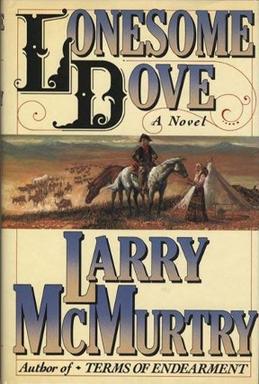
The Great Novels, vol. 1: Lonesome Dove


I am an avid reader. But I am also a re-reader. I have gone back to my favorite books many, many times and I always get a kick out of them. It's like reuniting with an old familiar friend. A great book can give you such a thrill when you read it for the first time. But the really great ones on repeated readings give you chills at how good they are even though there are no surprises waiting for you. Often this is because of wonderful, fully drawn characters. And that brings us to Lonesome Dove.

The first thing I tell people when I recommend Lonesome Dove is that I don't really care for Westerns very much. In fact, until I read Lonesome Dove, I would say that I didn't care for them at all. Aside from the occasional Western movie that held my interest, I never found them compelling or found the settings of Westerns very interesting. Often times, it seemed like a Western was just a story that could have been told in any setting. After all, The Magnificent Seven is just an inferior remake of Kurosawa's Seven Samurai, and that story is much more compelling given the Japanese setting and the code of the Samurai. Enter Larry McMurtry and his wonderful story, which was originally written as a teleplay. That it ultimately became a much-loved television miniseries after he decided to turn the teleplay into a novel is one of those great ironies. McMurty actually won the Pulitzer Prize for Lonesome Dove, and brother did he earn it.

The basic story is a simple one. Augustus "Gus" McCrae and Captain Woodrow Call are former Texas Rangers, past their prime and making a hard, honest living as cattlemen in Texas near the Mexican border. Gus is about as lazy as they come, but he has an easy manner about him that makes him instantly likable. While Gus spend his days drinking, gambling and whoring, Call is a tireless worker (and taskmaster), a no-nonsense fellow that demands respect from friend and foe alike. When their old Ranger buddy Jake Spoon rides into town and starts talking about the beautiful state of Montana, Gus and Call decide to pack up and drive their herd there. Gus is less than enthusiastic, but Call is not one easily swayed and before you know it, they are on their way.

The amazing thing about Lonesome Dove is the sheer number of characters, all of which are memorable. While Gus and Call are the main story, the novel follows other people as well, giving them tremendous lives and stories of their own. This is truly an ensemble piece. When the story heads off in the direction of another character, you find yourself wishing it would stay with the character you just read about. Yet when the story shifts again, you wish it would stay on the new character you just met. It's really something to behold and it speaks volumes about McMurtry's ability to create such vivid characters. Also of note is that there are very few inner dialogues that take place. Each character is defined by their words and their actions, not by long interludes of what is going through their mind. You become amazed at how well you get to know these people. When tragedies occur (and believe me, they do) you feel a real sense of loss. You realize that the west was a brutal place that took no sides; both good and bad suffered and often died as a matter of routine. McMurtry takes that western setting and make it come alive.

While every single story in Lonesome Dove is absorbing, I have a special place in my heart for Gus McRae. He's a man's man, who lives by a very real code all his own. He does things that will baffle you, infuriate you and amaze you. In all my years of reading, Gus McRae is my favorite fictional character. He's simply unforgettable.

So don't be scared if Westerns are not your thing. They're not really mine, either, or at least I sure thought that before I read Lonesome Dove. If you love epic storytelling and thoroughly memorable characters, saddle up and head to the library or local bookstore. Pick up Lonesome Dove and get ready for a remarkable read.

P.S. - Lonesome Dove spawned a sequel and two prequels. The sequel, Streets Of Laredo, is a solid, melancholy story that picks up a while after the events of Lonesome Dove. I'd give it a solid B as a grade. The first prequel, Dead Man's Walk, tells the story of how Gus and Call ended up in the Rangers and made enemies of the great Indian Buffalo Hump. Sadly, this book does not deliver what you would expect from McMurtry. The Gus and Call characters are basically oafs who rely on good fortune to stay alive. I'd score it a C-. The second sequel, Comanche Moon, picks up after the events of Dead Man's Walk and before Lonesome Dove. It finds McMurtry back in fine form. It's good enough to stand on it's own as an excellent tale. I give it an A-. Lonesome Dove is probably my favorite book, and I consider it to be the best novel I have read. It rates an A+.

Tuesday, March 18, 2008

The Great Albums, vol. 1: Jellyfish - Spilt Milk


One of the reasons I am doing the "Great Ones" series is to possibly expose people to some cool stuff they otherwise may never had found. So while the first in the Great Ones series was a movie (Seven Samurai) that most people have certainly heard of if not actually seen, the second is going to be something far more obscure, yet something I am equally enthusiastic about. And that brings us to one of the finest albums of the 1990's, Spilt Milk by the late, great Jellyfish.

Jellyfish was a band from San Francisco that made just 2 albums, but both are held in very high regard by those who have heard them. The first album was Bellybutton, released in 1990. It made a lot of critic's "Best Of 1990" lists and still holds up very well today. It is filled with strong tunes - the great melodies and witty lyrics that became synonymous with Jellyfish. But enough of that; we're here to talk about Spilt Milk.

Wrapped in pure pop bliss, inspired by the Beatles, Beach Boys and a generous dose of Queen, Spilt milk is a psychedelic trip through everything the flower power 60's strove for. But don't think it doesn't rock out as well; it's capable of rattling the bones with the best of them. Spilt Milk took a couple of years to record and was a very expensive endeavor. It shows in the finished product. The production is first rate, with all kinds of little touches that have you nodding your head, saying, "Yes, yes, this is exactly how this album should sound!" What's amazing is that almost all of those little touches were written into the songs from the get-go: one listen to the demos for Spilt Milk and you realize just how complete the songs were when they headed into the recording studio.

Things get off to a start with the dream-like "Hush," filled with gorgeous a cappella vocals that swirl around in your head. From there, the album really kicks into gear with "Joining A Fanclub,", a raucous, delightful song about fandom and it's perils. "Sabrina, Paste And Plato" follows, about the memories of grade school and first crushes. It's chorus is like the sweetest of candies.

"New Mistake"
is one of my favorite cuts on the album. The "mistake" in question is a new relationship and, eventually, a new baby. The singer goes from being unsure...

So father Mason, clutching his crucifix
Baptized the baby in whiskey and licorice
What a lovely way
Drowning sins in tooth decay

...to giddy happiness:

Any old way that I fall
I land in your arms/even tough it's wrong
Cause I love my new mistake

More great tracks follow: "The Glutton Of Sympathy" tells the tale of a lonely girl who will never learn, and "The Ghost At Number One" skews the record industry and sacred cows like artists who posthumously hit the charts. Throughout it all, the vocals soar, the harmonies intertwine perfectly and you find yourself giggling at the cleverness of it all.

I didn't intend this to be a blow-by-blow account of the album, but there are simply no weak songs here, and so many highlights. Trust me, you'll never hear an ode to masturbation as funny or honest as "He's My Best Friend." By the time "Brightest Day" comes along to close the album with it's big, carnival-like atmosphere:

come on and join the big charade
line up shut up clean up and shave
cause right behind you in the back of the fray
is a blade he's a renegade
turning bullshit into marmalade

...you realize that what you have heard is an absolute masterpiece, an album whose parts are absolutely tremendous, but as a whole is the equal to "Sgt. Pepper's Lonely Hearts Club Band." As a Beatles fanatic, I do not make such comparisons lightly. So check out Spilt Milk. It's the best album that John Lennon, Paul McCartney, Brian Wilson, Freddie Mercury and Brian May never made.

I should also note that the lead singer for Jellyfish (Andy Sturmer) was also the drummer. He played standing up and never missed a lick. It was a remarkable thing to see live, as this video will attest to. And for you gamers out there, Jellyfish also wrote one of the great videogame tributes. You can see it here.

I hope this post leads to just one person checking out Spilt Milk. Such an album should not remain in relative obscurity. If anyone does give it a listen or three, or already knows of the album, I'd love to hear from you.

Friday, March 14, 2008

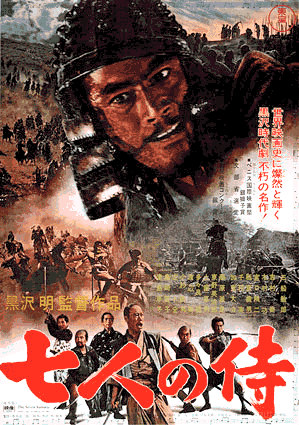
The Great Movies, volume 1: Seven Samurai


Choosing the first movie for my series of true excellence in entertainment was a no-brainer for me. I simply picked the movie that I consider the best ever made, or at least the best I have ever seen. Seven Samurai is an undisputed classic, arguably the greatest film made by arguably the greatest director in movie history. Akira Kurosawa's rousing epic has stood the test of time like few others. This is because the themes of the movie - honor, sacrifice, loyalty, bravery and kindness - are universal themes that have rarely been expressed as well on film. I know of no other movie that offers such a powerful glimpse of humanity at it's best and worst while also telling one hell of an adventure.

The story concerns a group of farmers in a village that are waiting for an attack by a gang marauding bandits. The farmers, who do not have the strength or the knowledge to fight back, know that the bandits will take all of their food and deal out unthinkable violence. In the past, the farmers have always endured the attacks and simply hoped that the bandits would leave them enough on which to survive. But one young villager says that he is sick of being kicked like a beaten dog and suggests they fight back. The other villagers are incredulous at this idea, some saying they would rather commit suicide then face another attack. But the idea gets approval from the village elder and it is decided that they will go to the nearest town and recruit wandering samurai warriors to help them. The problem? The villagers have nothing to offer these noble fighters except food, shelter and gratitude.

Thus begins the recruiting process, a marvelous sequence where we meet the men who will do this deed for the villagers simply out of honor. Each samurai has his own unique personality and story. There is the leader, Kambei, a war-weary veteran who is the first to accept the offer. He recruits others, including Kyuzo, a swordsman with no peer. When they head for the village there are seven of them ready to do what it takes to save the villagers. Well, actually, there are six and a half; tagging along is Kikuchiyo (the magnificent Toshiro Mifune), a peasant who has dreamed of being a real samurai. While the others do not take him seriously, he is anxious to prove his worth.

What unfolds is a terrific adventure, filled with action, humor, a little romance and humanity. Most of all humanity. Not all of the farmers are grateful that the samurai have come, fearful that they will take their women. And the farmers may not be exactly who the samurai think they are, either. In the second half of the film, when the bandits arrive, all will be tested in a battle not just for crops and sanctuary, but for honor, duty and the chance to live as real human beings.

Now for the caveats. Seven Samurai is in fact a Japanese film with Japanese language and English subtitles, so reading will be required. In addition, it is an older film, released in 1954, and it was filmed in black and white. It is also quite lengthy, clocking in at around three and a half hours. There is an intermission at about the halfway point. It is an epic story and the running time never seems excessive. It does not seem like a long movie while you are watching.

If you think you can deal with those three things, then you owe it to yourself to check out Seven Samurai. It is film making at it's absolute best, with a great director at the top of his game leading the way. Terrific performances, great storytelling and rousing action await you. I envy those those who get to see Seven Samurai for the first time.